Showing posts with label Matt Buccelli. Show all posts
Showing posts with label Matt Buccelli. Show all posts
Saturday, April 30, 2011
Waiting for Superman and Our Responsibility
By Matt Buccelli
 This past Monday, I was riding a bus back to DC from New York and happened to be sitting across the aisle from a GW student who had been in New York for an interview and became my friend for the trip. After we exchanged the usual pleasantries (school, major, class year, etc.), and I mentioned that I worked with DC Reads, my new travel companion (David was the kid's name) asked me about what it was like to work in the DC school system. Immediately this set off a very interesting conversation that I think says a lot both about the state of education reform in this country and about our broader responsibility as people who work in schools.

Tuesday, April 12, 2011
DC gets hosed, Gray gets arrested
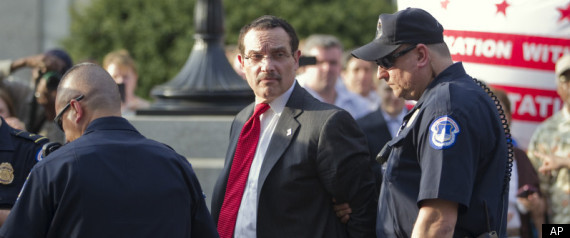

Although the ramifications of DC Mayor Vince Gray's arrest on Monday remain to be seen, it at least may have provided the optic that people like Mr. Plotkin have been waiting for.
Wednesday, December 8, 2010
Report: US only average at educating students
 By Matt Buccelli
A recent sample of test score data from around the world is causing significant concern among American education observers and public officials. The report, which tallied the math, science, and reading scores of 15 year-olds in each of the 34 countries within the Organization for Economic Cooperation and Development [OECD], demonstrates mediocre results for the United States, and shows us lagging behind many other Asian and European countries. On the 1,000 point scale of the International Student Assessment, we scored a 500 in reading, 502 in science, and 487 in math.
The results sounded alarm bells for many public officials. Education Secretary Arne Duncan referred to the results as "a massive wake-up call." Added Duncan: "Have we ever been satisfied as Americans being average in anything? Is that our aspiration? Our goal should be absolutely to lead the world in education."
Representative George Miller [D-CA], the outgoing chairman of the House Education Committee, expressed similar distress. "Average won't help us regain our global role as a leader in education. Average won't help our students get the jobs of tomorrow. Average is the status quo and it's failing our country."
Wednesday, October 27, 2010
DC Reads Program Snapshot: 4th and 5th Grade
We have four different tutoring programs within DC READS: our traditional one-to-one after-school tutoring for third graders; Saturday tutoring at libraries and community centers; morning tutoring, where we serve as de-facto teachers' assistants in classrooms for all the different elementary school grades; and then our 4th and 5th grade program, which functions as an after-school classroom run by a group of tutors and coordinators and focuses on personal development goals, writing, vocabulary, and other forms of student enrichment. Over the course of this year, we'll be posting a mixture of tutor and coordinator reflections to allow us to convey our experience as educators and mentors, while also filling our readers in on exciting developments within each of our programs.
****
Coordinator Reflection: Matt Buccelli
This past Thursday in our 4th and 5th grade classroom at Houston Elementary School, we had a "poetry café" to celebrate some of the work our students have been doing and give them a chance to share their creative material. For the previous two weeks, we had been teaching a unit on poetry and its different styles. After going over basic poetry terms like rhyme, couplet, alliteration, stanza, and syllable using the rap song "I Can," by Nas, we spent four classes teaching our kids to write acrostics, haiku, cinquains, and free verse poems. During each class, students had the chance to share their work quietly with a friend or individual teacher, but we intentionally put off having kids share their poems with the class and instead reminded our students during each lesson that if they behaved well and continued to worked hard, our efforts at writing would build up to a class spent sharing our poetry and eating treats. In each class building up to the poetry café, every student in class wrote at least one poem in each style; some who finished early wrote more, while others chose to draw illustrations to go along with their poems. Many of our students had the opportunity to draw illustrations but chose to write more poems instead.
Tuesday, September 28, 2010
Will Rhee stay or go?

By Matt Buccelli
After City Council Chairman Vincent Gray's triumph over incumbent Mayor Adrian Fenty in the September 14 DC mayoral primary, the jury is still out on what Gray's victory may mean for the future of DC Schools Chancellor Michelle Rhee. During Gray's tenure as council chair, he and Rhee have maintained a rocky relationship, and on the day after the primary, Rhee chose to characterize the result as "devastating for the children of Washington, DC." (ouch) Over the course of the campaign, Rhee signaled that she wouldn't work for Gray should he win, and given her engagement to the current mayor of Sacramento, California, she may be ready to skip town anyway. For his part, Gray remained mum during his bid for the mayoralty about whether or not he would keep Rhee, and has refused to make any decisions on administrative personnel until he is officially the mayor; even in heavily Democratic DC, the presumptive mayor-to-be still has to at least go through the motions of a general election in November.
Basically, we're unlikely to hear anything for awhile. But that shouldn't stop us from speculating anyway on what Gray's victory means for the Chancellor and for the future of DC education policy as a whole.
Tuesday, April 6, 2010
Chancellor's Forum Recap
By: Matt Buccelli
Last Wednesday night, I went with several other tutors and coordinators to one of DCPS chancellor Michelle Rhee's monthly community forums. This one took place at Kimball Elementary School in Ward 7, and the was centered around the district’s attempts to develop an action plan for improving DCPS high schools.
After an introduction by Chancellor Rhee, one of her deputies detailed how and why DC is moving forward with its plan to improve secondary schools. Rhee’s deputy said that DCPS is currently engaged in a three-phase plan for secondary school transformation --- after coming to agreement on expectations for high school students and tactics for moving forward, the school district will examine student performance and best practices from other urban school districts, and then create a final plan for meeting its expectations. In other words, DCPS’ “Vision for DCPS Secondary Schools,” as the forum was billed, is in its infancy.
DC Students Show Reading Gains
By: Matt Buccelli
Amidst a bevy of disappointing new federal reading data, modest gains in DC reading scores stand out as a bright spot.
A report from the National Assessment on Educational Progress (NAEP), which the federal government uses to monitor reading proficiency in the states, shows that while reading scores in 49 of 50 states have stalled while the No Child Left Behind law has been in effect, DC schools have made steady gains in reading since 2003. The DC NAEP scores remain below the national average, but DC joined Kentucky, which was the only state to achieve significant gains, as the only public school systems to improve steadily in reading since the enactment of No Child Left Behind.
To read the rest of the article, go to http://www.washingtonpost.com/
Subscribe to:
Posts (Atom)